How to Source Wireless Lavalier Microphones from China: The 2026 B2B Buyer's Guide
Product types, the specs that actually matter, how to test samples, what drives price, and how to tell a real factory from a trading company.
Key takeaways
- Most consumer wireless lav mics now use 2.4 GHz digital transmission with a plug-in receiver for phones or cameras. Decide your connector mix (USB-C, Lightning, 3.5 mm) before you request quotes.
- Judge samples on real-world range, dropouts, noise reduction and pairing, not on the spec sheet. Two kits with the same chipset can perform very differently.
- Unit price is driven mainly by the wireless solution, battery and charging case, enclosure finish and packaging. Logo printing alone rarely changes it much.
- Insist on test reports that match the exact model you buy (FCC, CE/RED, RoHS, UN38.3). Generic "certificates" are one of the most common sourcing traps.
Wireless lavalier microphones have become one of the most traded creator accessories in the world. They sell through Amazon, TikTok Shop, camera stores, education distributors and corporate gifting. Almost all of them are made in a handful of electronics clusters in southern China, and Shenzhen is the largest.
That concentration is good news for buyers. You can find capable factories at almost every price point. It also means the market is crowded with near-identical listings, traders posing as manufacturers, and spec sheets that promise more than the product delivers. This guide walks through how we would source a lav mic line if we were on your side of the table.
1. Know the main product types
Before talking to suppliers, be precise about which configuration you want. "Wireless lavalier mic" covers several quite different products.
| Configuration | Typical buyer | What to watch |
|---|---|---|
| 1 transmitter + phone receiver (USB-C or Lightning) | Entry-level creators, live sellers | Connector compatibility, phone-case clearance, charging pass-through |
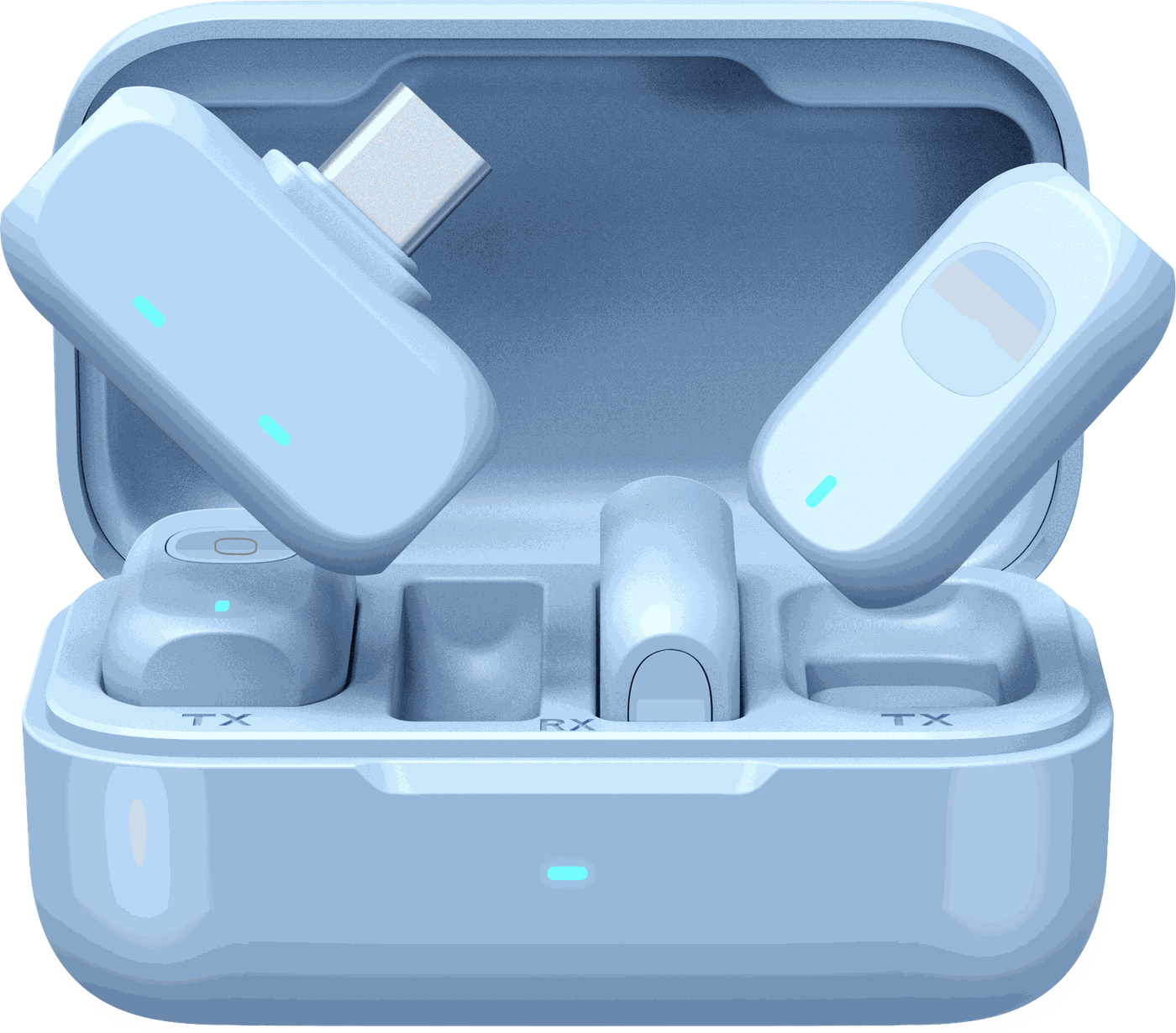
| 2 transmitters + 1 receiver ("dual" kit) | Interviews, podcasts, two-host streams | Stereo vs mono mix modes, independent mute, case charging both TX |
| Camera receiver with 3.5 mm TRS output | Vloggers using mirrorless cameras | Output level, cold-shoe mount, monitoring jack |
| Kits with charging case | Retail and gift channels | Case battery capacity, lid hinge durability, magnet strength |
| Transmitters with onboard recording | Prosumer and journalism | Storage capacity, file format, time-code or app support |
Since the iPhone 15 moved to USB-C in 2023, USB-C receivers cover most new phones. Lightning versions still sell in markets with many older iPhones. If you plan a Lightning receiver, ask whether the supplier holds the right Apple MFi arrangement or uses a non-certified solution. That affects both compatibility updates and which retail channels will accept the product.
2. The specs that actually matter
Spec sheets in this category are often copied from one supplier to the next. Treat every number as a claim to verify, and focus on the parameters that drive customer reviews.
Wireless performance and range
Many listings quote ranges such as "100 m" or more. Those figures usually come from open-field, line-of-sight tests. Indoors, with the transmitter on a body and the receiver in a phone, usable range is far shorter. The human body absorbs 2.4 GHz energy. Ask suppliers how they test range, and run your own test in a typical apartment or office (see section 4).
Latency
Digital wireless adds a small delay. For live streaming and video, lip-sync errors become noticeable when audio drifts too far from the picture. Ask for the measured latency, and check it on video with a clap test.
Noise reduction
Most kits offer one or two levels of DSP noise reduction. Strong noise reduction can make the voice sound "underwater" or clip the start of words. Listen to samples in a café-like environment with noise reduction on and off.
Battery life and charging
Ask for runtime per transmitter and how many recharges the case provides. Check whether the receiver can pass through charging to the phone while recording. Live sellers who stream for hours care about this a lot.
Microphone capsule and sound
Omnidirectional capsules are standard. Capsule quality and the acoustic design of the housing (port size, wind protection) matter more than frequency-response numbers on paper. Ask whether foam or furry windscreens are included or available.
3. Factory, trading company, or "factory-trader"?
You will meet three kinds of suppliers. None is automatically bad, but you should know which one you are dealing with:
- Manufacturers own assembly lines and usually some engineering capability (firmware, acoustics, structure). They control quality and can customise deeply.
- Trading companies source from multiple factories. They can be useful for small mixed orders but add a margin and a communication layer, and usually cannot change firmware.
- Factory-traders make some products themselves and source others. Ask clearly which models are produced in-house.
Practical checks: ask for a video call walking the production line, check the business licence scope, and ask engineering-level questions. Who writes the firmware? Which chip solution is used? Can the noise-reduction profile be adjusted? Our factory audit checklist goes deeper.
4. A sample-testing protocol you can run in a day
Order samples from two or three shortlisted suppliers and test them side by side. A simple, repeatable protocol beats impressions:
- Out-of-box pairing: time how long it takes a first-time user to get audio recording. Note any app requirement.
- Indoor range: record while walking away through rooms with doors. Note the distance where the first dropout occurs.
- Body blocking: clip the transmitter on the chest and turn your back to the receiver. Listen for dropouts.
- Noise test: play café or street noise from a speaker and record speech with each noise-reduction level.
- Latency: film a hand clap with the phone and check the audio offset in an editor.
- Battery: record continuously from full charge until shutdown, and check the case recharge count.
- Compatibility: test with several phones (iOS and Android), the native camera app and two or three popular apps.
- Build: open and close the case 200 times, test clip strength on thick and thin fabric, and check that magnets hold.
Keep the recordings. They become your reference "golden sample" standard for mass production.
5. What drives unit price
When quotes for similar-looking kits differ widely, the difference usually comes from these components:
- Wireless solution and DSP: the chipset platform and the engineering behind noise reduction and latency.
- Batteries: cell capacity, cell brand and protection circuitry, in both the transmitters and the case.
- Charging case: size, materials, hinge and magnet quality, and whether it has its own battery.
- Enclosure finish: matte vs glossy, soft-touch coating, metal parts, and colour-matched plastics.
- Packaging and accessories: retail box quality, windscreens, adapters, cables and pouches.
- Compliance: test costs spread over the order quantity, especially if reports must carry your brand name.
Logo printing, a custom colour box or translated manuals usually add little per unit at reasonable quantities. Tooling for a new housing is a different matter. See our guide to OEM customisation, MOQ and cost drivers.
6. Compliance: what to ask for
A wireless microphone is a radio transmitter with a lithium battery, so it is regulated in almost every market. At minimum, plan for:
- USA: FCC equipment authorisation for the radio (an FCC ID on the product or packaging).
- EU: CE marking under the Radio Equipment Directive, covering radio, EMC, safety and RF exposure, plus RoHS and REACH declarations. From 1 August 2025, internet-connected radio equipment must also meet the RED cybersecurity requirements. Simple non-connected mic kits are often outside that scope, but check with your lab.
- UK: UKCA, or CE where still accepted.
- Batteries: UN38.3 test summary and safety data sheet (SDS/MSDS) for shipping, plus IEC 62133 where retailers require it.
The key point: the report must match your exact model and version. Ask for the full test report, not just a certificate page. Check that the model number, photos and FCC ID match the sample in your hand. Our certification guide explains each item.
7. MOQ, lead time and payment norms
For standard models with your logo, factories commonly accept a few hundred to a thousand units per order. Custom colours, new packaging structures or firmware changes push MOQ higher. Plastic colour matching and packaging print runs have their own minimums.
Typical lead times run one to three weeks for standard stock and four to six weeks for customised orders after sample approval, longer around Chinese New Year. Payment is usually 30% deposit with balance before shipment. Use the deposit stage to lock the golden sample and the inspection criteria in writing.
8. Red flags
- Range or battery claims far above the rest of the market with no test method.
- Certificates that do not name the model, or that are issued by unknown "certification centres" rather than accredited labs.
- Reluctance to show the production line or to put engineering staff on a call.
- Prices that drop sharply after you push back. This can signal substitution of cheaper cells or capsules in mass production.
- No written quality standard, AQL or golden-sample agreement before the deposit.
9. Twenty questions to send every shortlisted supplier
Sending the same written questionnaire to each supplier makes quotes comparable and quickly shows who has real engineering depth. Ask them to answer in writing:
- Which wireless chip platform does this model use, and how long has it been in production?
- What is the measured latency, and how was it measured?
- How do you test range, indoors and outdoors, and what dropout criterion do you use?
- What are the transmitter and case battery capacities, and which cell supplier do you use?
- How many full transmitter recharges does the case provide?
- Does the receiver support charge pass-through to the phone while recording?
- Which connectors are available (USB-C, Lightning, 3.5 mm TRS), and are they the same PCB?
- How many noise-reduction levels are there, and can the profile be tuned for our market?
- Can voice prompts, LED behaviour and button functions be customised?
- Which test reports exist for this exact model (FCC, CE/RED, RoHS, UN38.3, SDS)? Please send the full reports.
- In whose name are the reports issued, and can they be issued for our brand?
- What is your MOQ for logo-only, custom colour and custom packaging orders?
- What is the lead time for samples, and for mass production after approval?
- What functional and audio tests are done on 100% of units?
- What AQL levels do you use at final inspection?
- What is your warranty policy, and do you supply a spare-parts ratio?
- Which components have changed in the last 12 months, and how do you notify customers of changes?
- Can we see the production line by video call this week?
- Which markets do your current customers sell into?
- Who is our single point of contact for engineering questions?
Pay attention to how the questions are answered as well as what the answers are. Vague answers to questions 1, 3, 10 and 17 are the strongest warning signs. Precise, documented answers usually predict a smooth production run.
10. Worked example: shortlisting three suppliers
Imagine a brand targeting US and EU creators with a dual USB-C kit. After sending the questionnaire, it shortlists three suppliers:
| Supplier A | Supplier B | Supplier C | |
|---|---|---|---|
| Quoted price | Lowest | Middle | Highest |
| Indoor dropout-free range (own test) | Short | Good | Good |
| Reports for exact model | Certificate page only | Full FCC + RED + UN38.3 | Full reports |
| Firmware customisation | No | Voice prompts and NR tuning | Yes, plus app |
| Production line video | Declined | Yes | Yes |
Supplier A looks cheapest, but its missing reports and weak range would cost more in returns and blocked listings than the price difference saves. Supplier C's app is attractive, but it may be more than the brand needs for version one. Supplier B is the balanced choice. The brand can revisit Supplier C for a premium version two once sales are proven.
Frequently asked questions
What MOQ should I expect for private-label wireless lav mics?
For an existing model with your logo and a standard box, a few hundred to about 1,000 units per order is common. Custom colours, new packaging structures or firmware changes usually require higher quantities.
Is 2.4 GHz or UHF better for a consumer lav mic?
For phone- and camera-based creators, 2.4 GHz digital is the mainstream choice because it is licence-free worldwide and fits small housings. UHF suits professional stage and broadcast use where range and spectrum planning matter. See our 2.4 GHz vs UHF comparison for details.
How many samples should I order?
Order at least two units of each shortlisted model, so you can test pairing between kits and keep one sealed as a reference. Then approve one golden sample before production.
Can the factory change the voice prompts or noise reduction?
A manufacturer with in-house firmware engineering can usually change voice prompts, indicator behaviour and noise-reduction profiles. A trading company typically cannot. Ask early, because firmware changes affect testing and lead time.
Talk to a factory engineer
Send us your target market, quantity and customization needs — we reply with a quotation, sample plan and certification checklist within 24 hours.
Request a Quote Browse Products