How to Sell Wireless Microphones on Amazon: Product, Compliance, Packaging and Listing
Choosing a model that earns good reviews, passing RF and battery compliance, FBA-ready packaging and listing content that reduces returns.
Key takeaways
- Reviews in this category are won or lost on compatibility, pairing simplicity and dropouts. Choose and test the product with that in mind.
- A wireless mic is both an RF device and a lithium-battery product. Have FCC/CE documentation and battery SDS/UN38.3 ready before you create the listing.
- In the EU, the General Product Safety Regulation (GPSR) and Extended Producer Responsibility (EPR) registrations add requirements beyond CE marking.
- Design packaging for FBA from day one: barcode placement, poly-bag warnings and carton specs.
Wireless lav mics are a natural fit for Amazon. They are small, light, giftable, and bought by a huge creator audience. They are also a crowded category where many listings look identical. The sellers who succeed usually don't win on the lowest price. They win on fewer returns, better reviews and smoother compliance. Here is the playbook we share with e-commerce customers.
1. Choose a product that earns good reviews
Read the one- and two-star reviews of the category leaders before you choose a model. In wireless mics, complaints cluster around a few themes:
- "Doesn't work with my phone": wrong connector, phone-case clearance, or app compatibility.
- "Cuts out": dropouts from body blocking or interference.
- "Sounds muffled": overly aggressive noise reduction or poor capsule placement.
- "Battery died / case broke": undersized cells, weak hinges or magnets.
- "Confusing setup": unclear pairing steps or indicator lights.
Choose a model that addresses these directly, and test it with the protocol in our sourcing guide. Small details like a slim receiver that fits through phone cases, or charge pass-through for live streaming, show up in reviews.
2. Plan variants carefully
Common variant structures are connector type (USB-C / Lightning), kit size (1 or 2 transmitters) and colour. Every variant multiplies inventory and compliance paperwork. Many sellers launch with one or two variants that cover most demand, then expand once reviews accumulate.
3. Compliance documents to prepare
RF (radio) compliance
For the US marketplace, a wireless microphone needs FCC equipment authorisation, and the FCC ID should appear on the product or packaging. Amazon may ask for the FCC ID or supporting documents for radio-frequency devices. In the EU and UK, you need the CE (Radio Equipment Directive) or UKCA declaration of conformity and the supporting test reports. See the certification guide for the full list.
Lithium batteries
Products containing lithium batteries go through Amazon's dangerous-goods (hazmat) review. Typically you must provide a safety data sheet (SDS) or an exemption sheet, and complete the battery attributes in the listing (battery type, number of cells, watt-hours or lithium content). Your factory should provide the UN38.3 test summary and SDS. Check that the battery details match the actual cells in your product.
EU-specific requirements
- GPSR: since 13 December 2024, products sold in the EU must identify the manufacturer and an EU-based responsible person. Safety information must be available on the product, packaging or accompanying documents, and in the online listing.
- EPR: in countries such as Germany and France, sellers need registrations for packaging, electrical equipment (WEEE) and batteries. Marketplaces check these numbers.
- Markings: CE mark, WEEE crossed-out bin symbol, and battery labelling as applicable.
4. FBA-ready packaging
- Barcode: plan a flat, scannable area for the FNSKU label, or have the factory print it on the box.
- Poly bags: bags above a certain opening size need a suffocation warning. Many sellers simply avoid loose poly bags.
- Drop resistance: the box must survive fulfilment-centre handling. Use rigid inserts that hold the case firmly.
- Carton specs: agree master-carton size, weight and labelling with the factory to match inbound requirements.
- Battery marks: outer cartons of lithium-battery equipment may need the lithium battery mark, depending on the shipping mode.
Packaging is also part of your brand. A clean box with a clear "works with" panel (phone icons, connector type) cuts wrong-purchase returns.
5. Listing content that converts and reduces returns
Title and bullets
Lead with the use case and compatibility. For example: "Wireless Lavalier Microphone for iPhone 15/16 and Android (USB-C), 2 Mics, Noise Reduction, Charging Case, for Vlogging, Live Streaming, Interviews". Use bullets to answer the questions that cause returns: which phones and connectors, how to pair, runtime per charge, and what's in the box.
Images
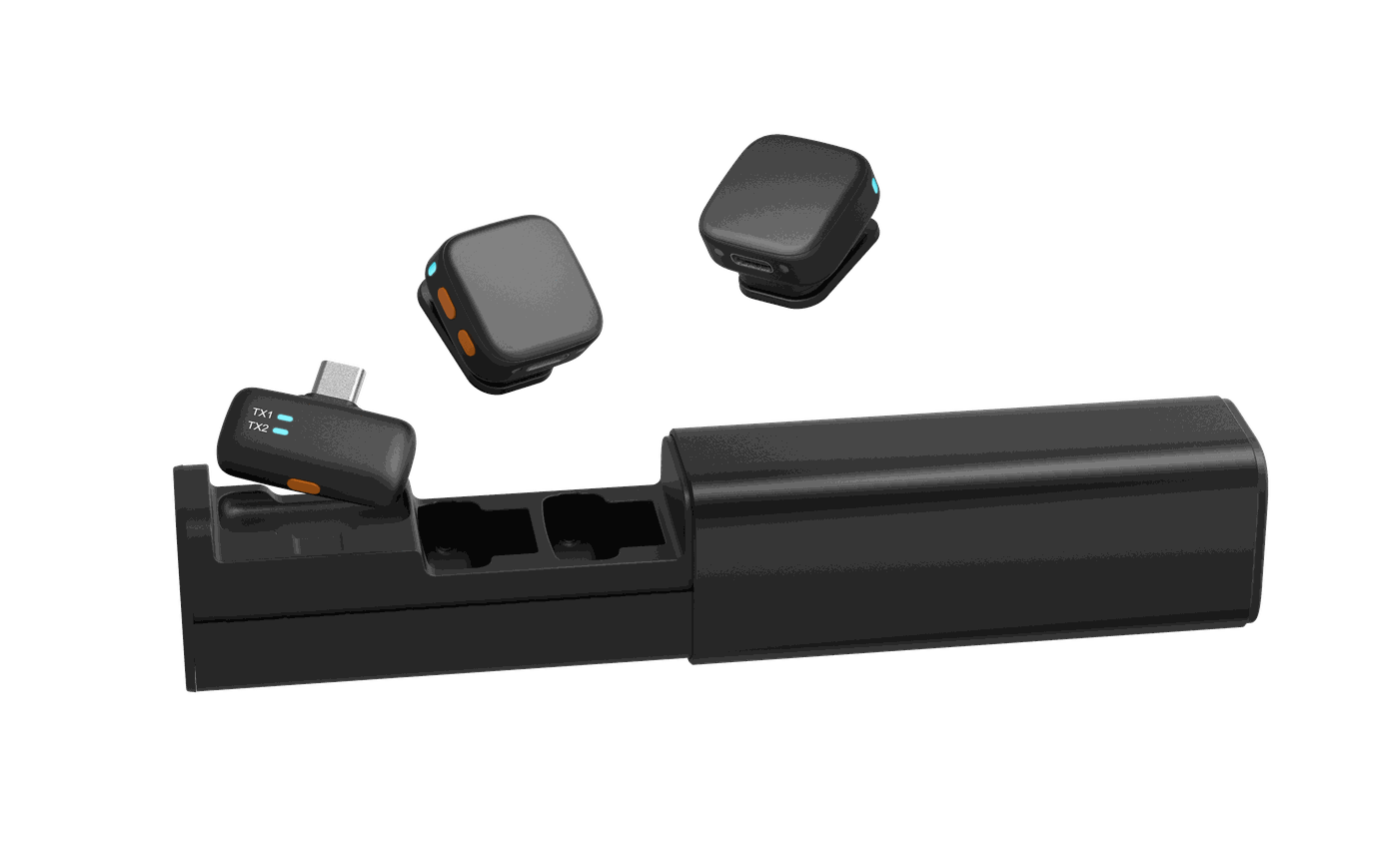
- Main image: product on white, case open, transmitters and receiver visible.
- Compatibility chart: connector type, plus clear "not compatible with" notes.
- Three-step setup graphic.
- Lifestyle shots: vlogging, live selling, interviews.
- Size reference: a transmitter on a shirt next to a coin or a hand.
- Battery and charging-case details.
Video and A+ content
A 30–60 second video of real audio, with noise reduction on and off, builds trust faster than any claim. Use A+ content for comparison tables across your own variants.
6. Pricing and positioning
The category spans entry-level single-mic kits to premium dual kits with onboard recording. Rather than racing to the bottom, pick a clear position. "Best for iPhone live sellers", "most compact" or "best value dual kit" are examples. Make sure the product genuinely delivers it. Bundles (extra windscreens, adapters, a carry pouch) raise perceived value at low cost.
7. After launch: use feedback to improve
- Track return reasons weekly, and send recurring issues to your factory with recordings or photos.
- Small firmware or accessory changes can fix a recurring complaint. Version-two improvements are where private-label brands pull ahead.
- Keep the golden sample and compare random production units against it every batch.
What a good factory partner should provide
- Test reports and declarations that match the exact model you sell.
- UN38.3 test summary and SDS for the batteries.
- Product photos, dimension drawings and spec sheets for your listing.
- FBA-compatible packaging and carton labelling.
- Willingness to act on review feedback in later batches.
A 60-day Amazon launch timeline
- Days 1–10: finalise the model and variants; confirm compliance documents with the factory; register your brand in Brand Registry if eligible.
- Days 10–25: packaging artwork with FNSKU, warnings and the "works with" panel; photography and video using pre-production samples.
- Days 25–40: mass production and pre-shipment inspection; create the listing and submit battery and RF information early to clear dangerous-goods review.
- Days 40–55: shipping to the fulfilment centre; prepare A+ content and launch promotions.
- Days 55–60: go live; monitor reviews and returns daily for the first weeks.
The most common delay is the dangerous-goods review. Submitting accurate battery documentation while production is running, rather than after goods arrive, saves weeks.
Turning returns into product improvements
Return reasons and reviews are free product research. Categorise every return and negative review into a few buckets, and act on the largest:
| Return reason | Likely root cause | Fix |
|---|---|---|
| "Not compatible" | Listing unclear, or receiver too wide for cases | Clearer compatibility images; slimmer receiver or extension adapter in box |
| "Stops working" | Pairing confusion, or battery protection triggering | Better quick-start card; firmware tuning; check cell quality |
| "Audio cuts out" | Body blocking, user placement | Placement guidance in manual and images; antenna improvement in next version |
| "Poor sound" | Noise reduction too strong by default | Change default NR level in firmware |
| "Case broken" | Hinge or magnet weakness | Factory improvement and incoming inspection on case parts |
Share this table with your factory every month. A manufacturer with in-house engineering can often fix the top issue within one or two production batches. That's one of the clearest advantages of working directly with a factory rather than a trader.
Expanding to other Amazon marketplaces
Once a product works in one marketplace, expansion seems easy, but each region adds requirements. The US needs the FCC ID and English documentation. The EU needs CE/RED documentation, GPSR information, EPR registrations and local-language instructions. The UK needs UKCA or accepted CE marking and a UK-based responsible party for many products. Japan needs radio conformity marks, and PSE where applicable for lithium-ion batteries. Plan the packaging so that markings and languages can cover several markets with minimal SKUs.
Frequently asked questions
Do I need my own FCC certification?
Not necessarily. Many sellers rely on the manufacturer's FCC authorisation for the exact model. If you change the design, or want the grant or reports in your company name, you may need your own testing. Confirm with your test lab.
Why was my wireless mic listing flagged as hazmat?
Products with lithium batteries go through Amazon's dangerous-goods review. Provide an accurate SDS or exemption sheet and complete the battery information in the listing. Delays often come from mismatched battery data.
What is the EU responsible person under GPSR?
For many products sold in the EU, an economic operator established in the EU must be identified on the product or its packaging or documents. That can be the manufacturer, importer, authorised representative or a fulfilment service provider. It must also be shown in the online listing.
How do I reduce returns for wireless mics?
Be explicit about compatibility, show the setup in three steps, test against common phone cases, and set realistic range and battery claims. Most returns come from mismatched expectations rather than defects.
Talk to a factory engineer
Send us your target market, quantity and customization needs — we reply with a quotation, sample plan and certification checklist within 24 hours.
Request a Quote Browse Products