How to Audit a Consumer Electronics Factory in China: A Practical Checklist
Verify you're dealing with a real manufacturer, then check quality systems, test equipment, battery handling, capacity and inspection standards — on site or by video.
Key takeaways
- Start by confirming you are talking to the actual manufacturer of your product, not just "a factory".
- For audio and wireless products, the critical checks are incoming component control, functional/RF/audio testing, battery handling and ESD protection.
- Agree inspection standards (AQL levels, test list, golden sample) before production, not at the final inspection.
- A video audit is fine for a first screen. Use an on-site or third-party audit before large or long-term orders.
A factory audit is not about catching suppliers out. It is about understanding whether a factory can make your product consistently, at your volume, to your standard. For consumer electronics such as wireless microphones, voice amplifiers and smart devices, the risks are specific. Components get substituted, batteries are poorly handled, testing is skipped, and capacity is overstated in peak season. This checklist focuses on those.
1. Verify the manufacturer
- Business licence: check the company name, registration and business scope. Does it include manufacturing, or only trading?
- Address match: does the factory address match the licence and the shipping documents? Many groups run several entities. That's fine, as long as it's transparent.
- Product evidence: ask to see your exact product, or its sub-assemblies, being built and tested. Showrooms full of different products do not prove manufacturing.
- Engineering access: can you speak to the engineer responsible for the product's firmware, acoustics or RF? Real manufacturers can arrange this.
- Export history: ask for references or anonymised examples in your market, and check whether they understand that market's compliance requirements.
2. Quality management system
ISO 9001 certification is a good sign, but look at how it works on the floor:
- IQC (incoming quality control): how are chips, batteries, capsules and plastics inspected on arrival? Are there sampling records and approved vendor lists?
- IPQC (in-process control): are there inspection stations in the assembly line, and do they keep records?
- FQC/OQC (final/outgoing quality): what is tested on every unit, and what is sampled?
- Non-conformance handling: how are defects logged, analysed and corrected? Ask to see a recent corrective-action report.
- Traceability: can a unit's batch, production date and component lots be traced? This matters if a battery or component issue appears later.
3. Test equipment for audio and wireless products
| Test | What to look for |
|---|---|
| Functional test | Every unit powered and checked: pairing, buttons, LEDs, charging |
| Audio test | Acoustic test box or audio analyser for frequency response, noise and distortion; a listening check alone isn't enough |
| RF test | Output power and frequency checks on the line or in sampling |
| Battery / charging test | Charge current, protection function, capacity sampling |
| Ageing / burn-in | Units run for a period to catch early failures |
| Reliability lab | Drop, button life, cable bend, temperature and humidity on samples |
Ask the factory to run the tests for your product while you watch, in person or on video. Check calibration labels on key instruments.
4. Battery handling and safety
Lithium batteries are the highest-risk component in most portable electronics.
- Are cells sourced from named suppliers with specifications and UN38.3 documentation?
- Is battery storage separated, temperature-controlled and equipped with fire protection?
- Are cells inspected on arrival (voltage, internal resistance, appearance)?
- Are swollen or damaged cells quarantined and disposed of properly?
- Is there a documented charging test and protection-circuit check before packing?
5. ESD and workmanship
- ESD wrist straps, mats and grounded workstations wherever PCBAs are handled.
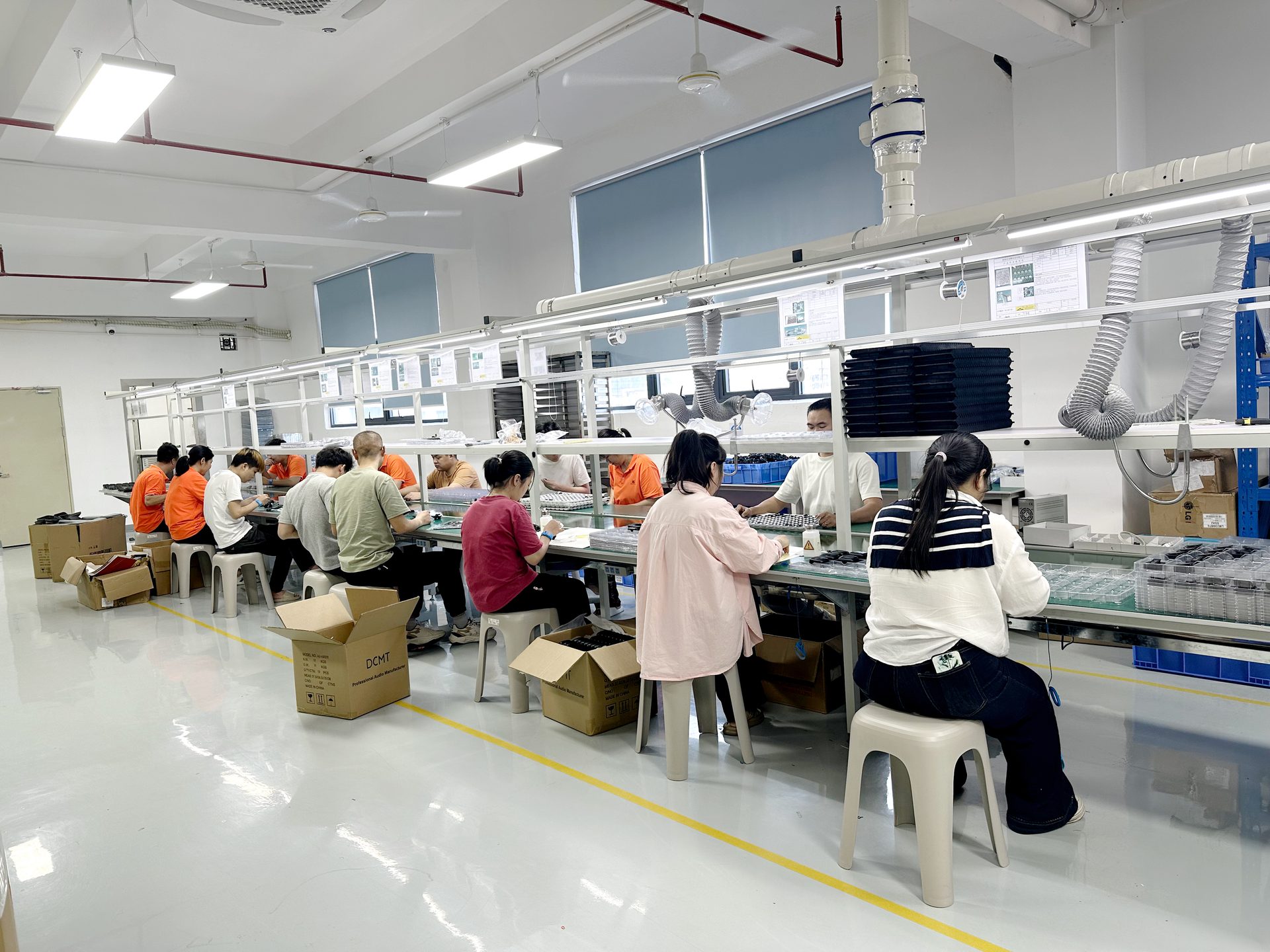
- Clean, organised lines with clear work instructions at each station.
- Soldering quality: inspect samples for cold joints and flux residue, or check whether the factory uses AOI (automated optical inspection) for SMT.
- Material segregation, so good parts, rejects and rework are clearly separated.
6. Capacity and planning
- Daily output per line for your product, and the number of lines that can build it.
- Current load: how full is the factory over your production window, including peak season and before Chinese New Year?
- Lead times of critical components (chips, cells), and whether the factory keeps safety stock.
- Subcontracting: which processes (SMT, injection moulding, packaging) are done in-house and which are outsourced? Outsourcing is normal, but you should know.
7. Inspection standards: AQL explained
Most buyers use acceptance sampling based on ISO 2859-1 (equivalent to ANSI/ASQ Z1.4) for final inspection. You choose an inspection level and an AQL (acceptance quality limit) for each defect class. A common starting point for consumer electronics:
| Defect class | Example | Common AQL |
|---|---|---|
| Critical | Safety hazard, battery swelling, exposed live parts | 0 (none accepted) |
| Major | No pairing, no audio, dead button, wrong accessory | 1.0–2.5 |
| Minor | Small scratch, slight print offset | 2.5–4.0 |
These limits are usually applied at general inspection level II. Write your functional test list, cosmetic standards and golden sample into the purchase agreement. Third-party inspection companies can carry out pre-shipment inspection on your behalf.
8. Social and environmental compliance
Many retailers require social audits such as amfori BSCI, SMETA or similar schemes, and some require environmental or chemical compliance programmes. Ask whether the factory already holds a recent audit report, and when it expires. Even if your customers don't demand it today, basic checks on working hours, safety exits and fire equipment protect your brand.
9. Running a video audit
- Send the agenda in advance: entrance and signage, warehouse, IQC area, SMT/assembly, test stations, battery storage, packing, QC office.
- Ask for a continuous walk-through rather than edited clips.
- Ask to see your product on the line, or a similar product from the same platform.
- Request close-ups of test screens, records and calibration labels.
- Follow up in writing with what you saw and any open questions.
Simple audit scorecard
| Area | Questions | Score 1–5 |
|---|---|---|
| Legitimacy | Licence, address, real manufacturing of your product | |
| Engineering | Firmware/acoustic/RF capability, change control | |
| Quality system | IQC/IPQC/OQC, records, corrective actions | |
| Testing | Functional, audio, RF, battery, reliability | |
| Battery safety | Sourcing, storage, inspection | |
| Capacity | Output, load, component planning | |
| Communication | Responsiveness, documentation, English capability |
10. Change control: the risk after the audit
A factory can pass an audit and still cause problems later if components or processes change without notice. It's one of the most common sources of quality drift in electronics. To manage it:
- Include a change notification clause in your agreement. Any change to critical components (chipset, battery cells, microphone capsule, speaker), suppliers or processes requires written approval.
- Define critical components in a short list attached to the spec.
- Compare every production batch against the golden sample, at least on sound, battery runtime and appearance.
- Ask for first-article samples when any approved change is introduced.
11. The pre-production meeting
Before mass production starts, a short pre-production meeting (on site or by video) prevents most misunderstandings. Cover these points:
- Golden sample review: hardware, firmware version, packaging and accessories.
- Materials check: correct colours, cells, capsules and printed packaging received.
- Test plan walk-through: which tests at which station, with pass/fail criteria.
- Labelling: barcodes, compliance marks, carton marks and shipping marks.
- Schedule: production start, inspection date and shipping date.
Record the meeting outcome in writing and share it with both the factory and your inspector.
12. Red flags during an audit
- The production area is idle or shows unrelated products, and the explanation keeps changing.
- Test stations exist but there are no records, or records are filled in neatly in one handwriting style.
- Batteries are stored loosely near production lines without separation or fire protection.
- ESD equipment is present but not connected or used.
- Management cannot explain how a defect found at final inspection is traced back to its cause.
- Requests to see a specific area are delayed until "next time".
None of these automatically disqualifies a supplier. Each is a topic for a direct conversation and, if needed, a follow-up visit before you commit volume.
Frequently asked questions
Is a video factory audit enough?
For a first screen and small orders, a structured video audit is often enough. For large or long-term programmes, a physical visit or a third-party audit gives much more confidence, especially on battery handling and testing.
What AQL should I use for electronics?
A common approach is 0 for critical defects, 1.0–2.5 for major and 2.5–4.0 for minor defects, at general inspection level II. Adjust to your product risk and customer expectations.
How can I tell a trading company from a factory?
Check the business licence scope, ask to see your specific product being assembled and tested, and ask to speak with the responsible engineer. Trading companies often show many unrelated products and avoid technical detail.
Can I bring my own inspector?
Yes. Reputable manufacturers welcome third-party inspection before shipment. Agree the inspection standard and test list in advance so the results aren't disputed.
Talk to a factory engineer
Send us your target market, quantity and customization needs — we reply with a quotation, sample plan and certification checklist within 24 hours.
Request a Quote Browse Products