Portable Voice Amplifier Buying Guide for Distributors and Brands
Output power, microphone types, battery life, feedback control and the quality checks that separate a reliable voice amplifier from a return magnet.
Key takeaways
- Match the amplifier to the user and the space. A classroom, a museum tour and an outdoor fitness class need different power and microphone setups.
- Feedback (howling) control, clarity and comfort matter more than peak wattage numbers.
- Battery life claims must be tested at realistic volume. Ask how the supplier measures runtime.
- Durability of headset cables, connectors and buttons drives most after-sales issues.
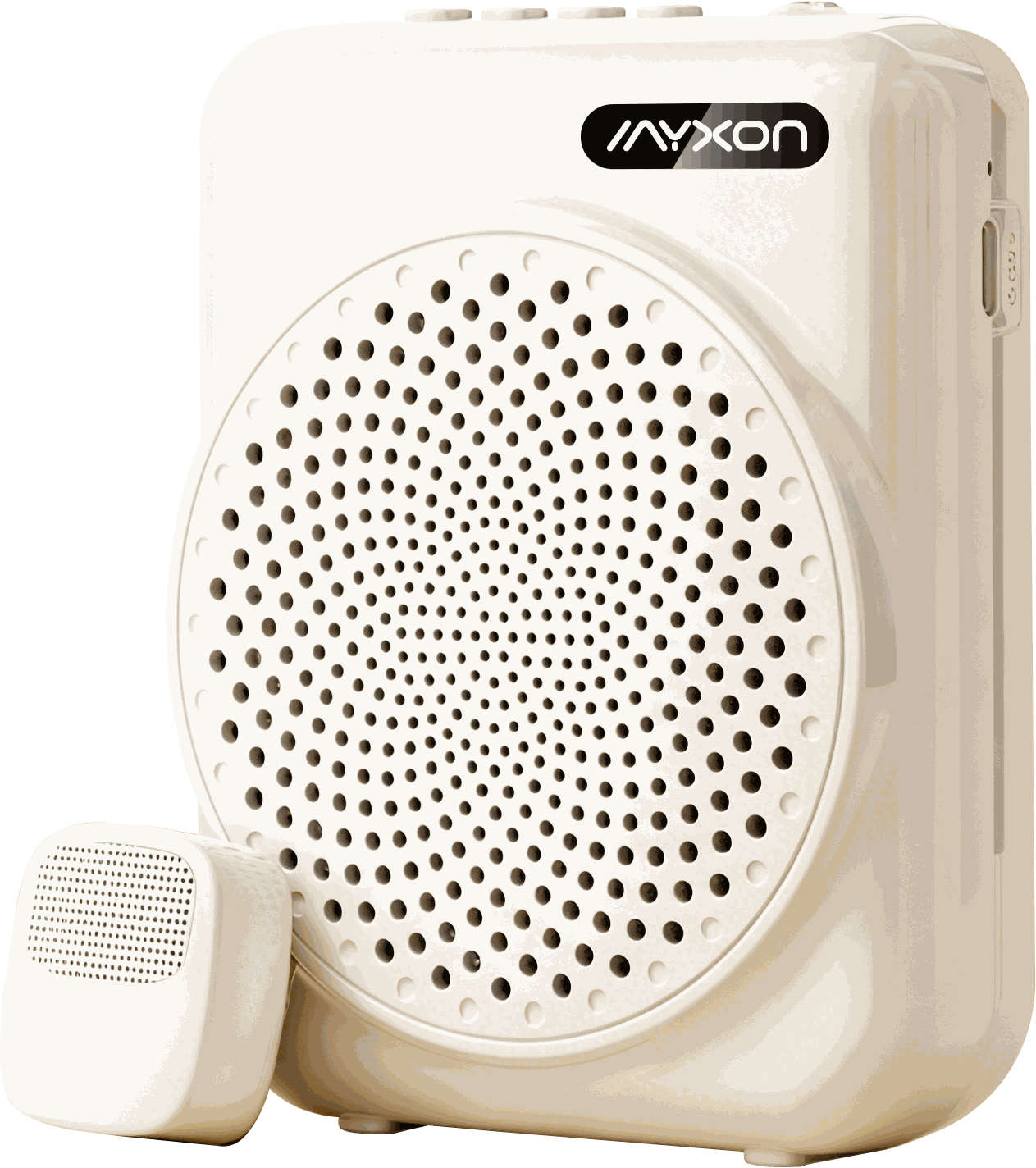
Portable voice amplifiers, called "little bees" in China after their buzzing popularity with teachers, solve a simple problem. They let one person be heard by a group without straining their voice. Teachers, tour guides, fitness instructors, sales promoters, factory trainers and market vendors all use them. For distributors, they are a steady, repeat-purchase category with clear use cases. Here is how to choose models that sell and stay sold.
1. Know your user segments
| User | Environment | Priorities |
|---|---|---|
| Teachers | Classroom, 20–50 people | Clarity, all-day battery, light weight, low feedback |
| Tour guides | Indoor museums and outdoor streets | Higher output, wind handling, portability, wireless mic option |
| Fitness instructors | Gyms and outdoor classes with music | Sweat resistance, secure headset, music playback |
| Sales promoters / vendors | Shops, markets, events | Loudness, recording and loop playback, durability |
| Corporate trainers | Meeting rooms, factory floors | Clarity, professional look, wireless freedom |
A focused range of three or four models covering these segments usually beats a long catalogue of similar units.
2. Output power: watts aren't everything
Power ratings are often quoted as peak or "max" watts, which can't be compared between brands. What matters to the user is clear, undistorted voice at the distance they need. In practice:
- Small rooms and classrooms: modest power is enough. Clarity and feedback control matter more.
- Large rooms and outdoors: more power and a larger speaker help, but weight and battery drain go up.
Ask suppliers for the rated (not peak) output and the speaker size. Then compare samples side by side at a fixed distance, listening for distortion at high volume.
3. Microphone options
- Wired headset: the most common and affordable. The mic stays at a fixed distance from the mouth, which helps prevent feedback. Cable and plug durability are the weak points.
- Wireless headset (2.4 GHz or UHF): frees the user from the cable, so the amplifier can sit on a desk or on a stand. It costs more, and both units need charging. See 2.4 GHz vs UHF.
- Collar / lavalier mic: discreet, but it picks up more room sound and is more feedback-prone.
- Handheld mic: useful for promoters and Q&A, less so for hands-free teaching.
Headset comfort is often ignored in sourcing and often mentioned in reviews. Test it for an hour, with and without glasses.
4. Feedback (howling) control
Feedback happens when the mic picks up its own amplified sound. The design factors that reduce it are mic directionality, distance from the speaker, DSP feedback suppression and the frequency response of the speaker. Test each sample by walking close to the amplifier at high volume. A good unit stays stable, while a poor one squeals. This single test eliminates many low-quality options.
5. Battery and charging
- Ask how runtime is measured: at what volume, with or without music playback.
- Check charging time and connector (USB-C is now expected in most markets).
- Ask about battery cell source, capacity and protection circuitry. Request the UN38.3 summary and SDS for shipping.
- Consider whether users need to replace batteries. In the EU, the new Batteries Regulation brings end-user replaceability requirements for portable batteries from 2027 (with exceptions), which affects some designs.
6. Features that add value (and some that don't)
| Feature | Who values it | Note |
|---|---|---|
| Bluetooth speaker mode | Fitness, teachers using videos | Useful, low cost on many platforms |
| USB / TF card playback | Promoters, vendors | Loop playback of ads is popular in markets |
| Recording | Teachers, promoters | Record a message once, replay it |
| FM radio | Some regional markets | Rarely a deciding factor |
| Volume memory / quick mute | All users | Small, but appreciated |
| Voice prompts | All users | Must match the target language; can be customised |
7. Quality checks before you buy
- Clarity at distance: record speech from 5–10 metres and listen for intelligibility.
- Feedback test: high volume, mic approaching the speaker.
- Runtime test: continuous speech playback at typical volume until shutdown.
- Cable and plug: bend tests at the headset cable entry and plug, which is the top failure point.
- Buttons and knobs: repeated presses and rotation; no crackle when adjusting volume.
- Belt clip and strap: pull test; check stitching and clip spring.
- Drop test: a modest drop onto a hard floor, as happens in classrooms.
For production orders, write these tests into your inspection checklist, and use the AQL approach in our factory audit guide.
8. Compliance
Voice amplifiers with Bluetooth or wireless mics are radio equipment: FCC in the US, CE/RED in the EU. Wired-only models still need EMC and safety compliance, plus RoHS. Lithium batteries need UN38.3 and an SDS for transport. See the full certification guide.
9. Wholesale and private-label tips
- Offer school and tour-operator bundles: amplifier plus spare headset plus pouch.
- Stock spare headsets and cables. They are the most-requested replacement parts and a nice margin line.
- Translate voice prompts and manuals for each market; the factory can usually customise prompts.
- For gift and lifestyle channels, design-led models with colour prints sell on looks as well as function.
10. How to read a voice amplifier spec sheet
| Spec line | What it really tells you | What to ask |
|---|---|---|
| Output power (W) | Often peak power; not comparable across brands | Rated power, at what distortion level |
| Speaker size | Larger drivers move more air and sound fuller | Driver type and magnet; enclosure design |
| Battery (mAh) | Capacity of the cell, not runtime | Runtime at stated volume; cell supplier |
| Runtime (h) | Usually measured at low volume | Test method and volume level |
| Frequency response | Range of reproduced frequencies | Is it tuned for speech clarity? |
| Weight | Comfort over a full day | Weight with battery and headset |
| Wireless range | Only for wireless mic models | Indoor test with body blocking |
11. Worked example: building a school-channel range
A distributor serving primary and secondary schools wants a simple three-model range:
- Entry model: compact amplifier with wired headset, all-day battery, USB-C charging. It is the volume seller for individual teachers.
- Mid model: slightly larger speaker, Bluetooth playback for lesson videos, recording function. Aimed at teachers who use multimedia.
- Premium model: wireless headset, larger speaker, stand or desk use. Aimed at lecture halls, PE teachers and school events.
Each model ships with a spare foam cover and a clear one-page quick guide in the local language. Spare headsets are sold separately. The distributor asks the factory for a unified colour scheme across the range and a school-pack carton of ten units for easy distribution. The result is a range that is easy to explain to procurement staff and easy to support after sale.
12. After-sales planning
Voice amplifiers are used intensively, so a little after-sales planning goes a long way:
- Agree a spare-parts ratio (headsets, cables, foam covers) with each production order.
- Keep a troubleshooting sheet for common issues: no sound (headset plug not fully inserted), feedback (mic too close to speaker), short runtime (volume too high, or battery ageing).
- Track serial or batch numbers so recurring faults can be traced to a production lot.
- Collect feedback from heavy users such as tour guides and fitness instructors, who expose design weaknesses fastest.
Frequently asked questions
How much power does a classroom voice amplifier need?
For a typical classroom, a modest rated output is enough if the unit is clear and well tuned. Larger halls or outdoor groups benefit from higher output and a bigger speaker. Compare samples at a fixed distance rather than relying on peak watt figures.
Wired or wireless headset: which is better?
Wired headsets are cheaper, need no extra charging and are reliable if the cable is well made. Wireless headsets give more freedom and let the amplifier sit away from the body, which can also reduce feedback. They cost more, and two devices need charging.
Why does my voice amplifier squeal?
That is acoustic feedback: the microphone is picking up sound from the speaker. Keep the mic close to the mouth and away from the speaker, lower the volume slightly, or use a model with better directional mics and DSP feedback suppression.
Can the factory customise voice prompts and colours?
Most manufacturers can change voice-prompt language, logo, colours and packaging for OEM orders. New housing shapes require tooling and a higher commitment.
Talk to a factory engineer
Send us your target market, quantity and customization needs — we reply with a quotation, sample plan and certification checklist within 24 hours.
Request a Quote Browse Products